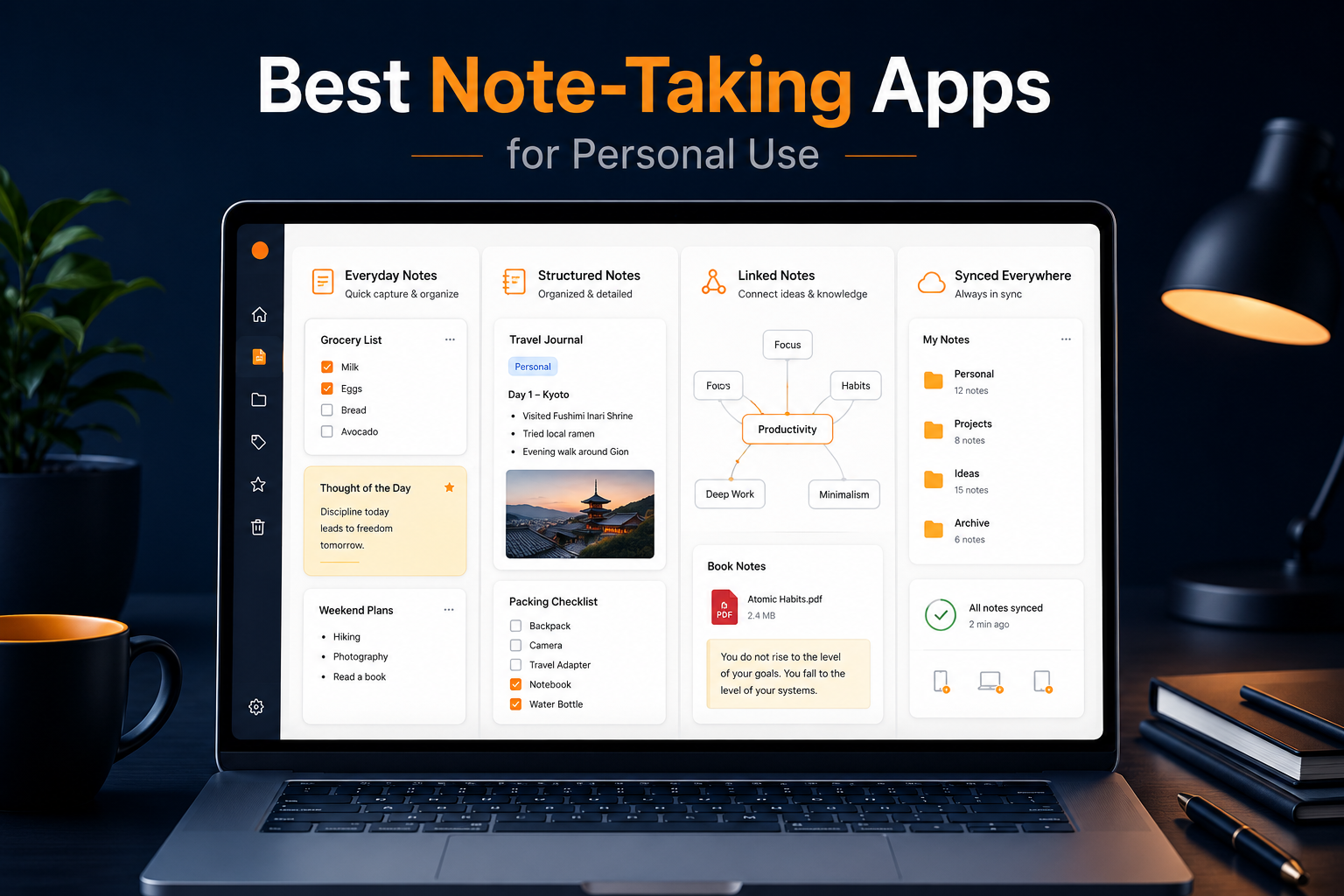
Best Note-Taking Apps for Personal Use: Find Your Fit
Quick Verdict
Choosing a note-taking app sounds simple until you realize that “taking notes” can mean completely different things.
One person needs somewhere to save a shopping list and a few ideas. Another wants a searchable archive of articles, receipts, meeting notes, and scanned documents. Someone else is building a personal knowledge base they expect to keep for the next decade.
Those users should not choose the same app.
Our recommendations are:
| How You Actually Take Notes | Best Choice |
|---|---|
| You want notes, databases, projects, and dashboards together | Notion |
| You save articles, documents, scans, and information from everywhere | Evernote |
| You want local files, linked ideas, and long-term ownership | Obsidian |
| You take handwritten, visual, audio, or PDF-based notes | OneNote |
| You use Apple devices and want almost no setup | Apple Notes |
| You want open-source software and stronger privacy control | Joplin |
Notion is the most flexible choice, but it can become unnecessarily complicated when all you need is a notebook.
Evernote remains strong for capturing information and finding it later, although its current paid plans are expensive compared with several alternatives.
Obsidian is the most convincing long-term choice for people who care about owning their files and building connections between ideas.
OneNote is still one of the best free options for handwriting, PDF printouts, classes, meetings, and visually arranged notes.
Apple Notes is not the most advanced app here, but for someone living entirely inside the Apple ecosystem, its speed and convenience may matter more than a longer feature list.
Joplin is the strongest alternative for users who want open-source software, local control, cross-platform access, and end-to-end encryption.
The Note-Taking App Question Is Really a Trust Question
A note is often written for your future self.
You capture an idea today because you believe you will be able to find and understand it three months from now. That makes a note-taking app more than an editor. It becomes a place where you trust parts of your memory.
This is why switching apps can become surprisingly emotional. People do not only migrate text. They migrate years of unfinished thoughts, saved articles, meeting decisions, receipts, plans, and personal history.
The best app is therefore not necessarily the one with the most advanced interface. It is the one you can trust to remain usable when your collection grows from fifty notes to five thousand.
Best Note-Taking Apps for Personal Use: The Fast Decision
Choose Notion when a note often becomes a project, database entry, content plan, reading list, or dashboard.
Choose Evernote when your main problem is capturing information from many sources and retrieving it later.
Choose Obsidian when you want notes stored as local files and prefer building a network of ideas over maintaining a conventional notebook structure.
Choose OneNote when your notes are visual, handwritten, classroom-based, meeting-based, or built around documents and PDF printouts.
Choose Apple Notes when convenience matters most and your personal devices are already from Apple.
Choose Joplin when privacy, open formats, offline access, and software independence matter more than a polished commercial interface.
That is the real decision. The rest of the article explains the trade-offs behind it.
Notion: When Notes Are Part of a Larger System
Notion is often described as a note-taking app, but that description is incomplete.
A normal note app gives you pages and folders. Notion gives you pages, databases, properties, relationships, views, subtasks, templates, calendars, forms, and publishing tools.
That makes it useful when your notes are connected to something larger.
A writer can connect research notes to an editorial calendar. A job seeker can connect company research to an application tracker. A student can connect course notes to assignments, deadlines, and reading lists.
Notion’s Free plan is intended for individuals organizing personal projects and life. It includes unlimited pages and blocks for an individual workspace, although individual file uploads are limited to 5 MB.
Where Notion Feels Excellent
Notion becomes valuable when information needs structure.
For example, a reading database can contain:
- The book title;
- Author;
- Status;
- Topic;
- Rating;
- Notes;
- Related projects.
The same information in a traditional notebook would be spread across several pages. In Notion, it can be filtered, sorted, grouped, and viewed differently without duplicating it.
This is why Notion works particularly well for content planning, travel research, goal tracking, study systems, personal projects, and knowledge organization.
Where Notion Becomes Frustrating
Notion can make simple note-taking feel like database administration.
A person who only wants to capture an idea quickly may not need properties, templates, relations, views, or carefully designed dashboards. The flexibility that attracts users can also create setup fatigue.
Notion now supports selected pages for offline use, while paid plans can automatically download recent and favorite pages. It remains more cloud-oriented than a local-first app such as Obsidian.
Notion is best when you enjoy creating structure and will actually maintain it.
It is a poor choice when building the system becomes more interesting than using the notes inside it.
Notion Pricing
| Plan | Monthly Billing | Annual Billing Equivalent | Best For |
| Free | $0 | $0 | Personal notes and basic organization |
| Plus | $12/month | $10/month | Larger files, history, charts, and advanced personal systems |
| Business | $24/month | $20/month | Teams, advanced permissions, and AI workflows |
Notion’s current official pricing page displays Plus at $10 per member per month and Business at $20 when paid yearly. Notion’s published monthly price for Plus is $12, with yearly billing saving up to 20%.
For most individual note-takers, the Free plan is enough unless file limits, longer history, or more advanced publishing features become a recurring problem.
The Best Notion User
Choose Notion when you want your notes to live beside projects, databases, tasks, calendars, and other organized information.
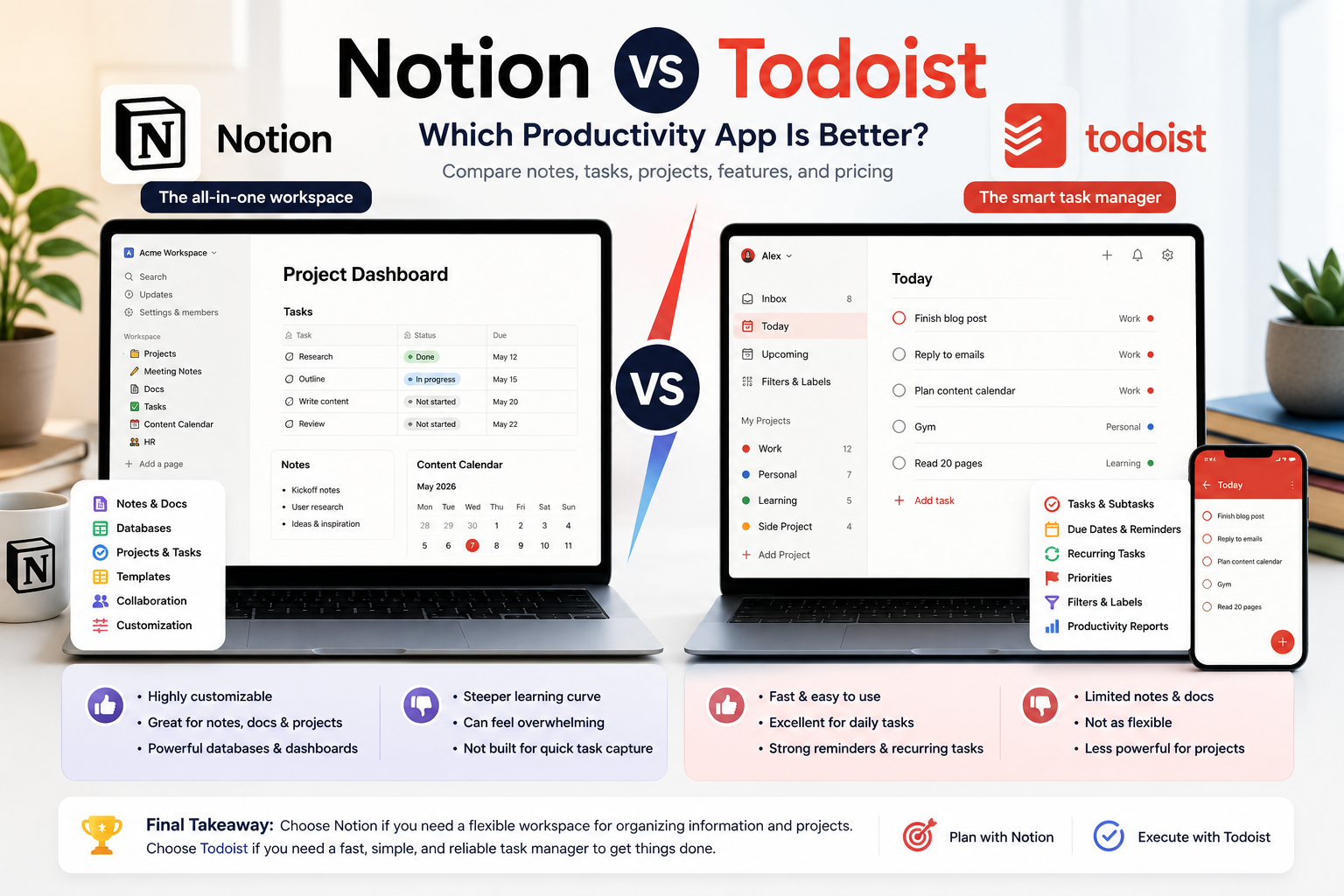
Notion can also manage tasks, but that does not necessarily make it the best daily task manager. Its strength is connecting notes, projects, databases, and supporting information, while Todoist is designed around faster task capture and execution. Our Notion vs Todoist comparison explains which approach works better depending on whether you need a flexible workspace or a focused system for completing tasks.
Evernote: When Capturing Everything Matters Most
Evernote is built around a different idea.
Instead of asking you to design a personal system, it focuses on capturing information from almost anywhere and making it searchable later.
You can type notes, scan documents, save web pages, clip articles and PDFs, record information, attach files, and organize everything with notebooks and tags.
That makes Evernote particularly useful for people who treat their note app as a digital filing cabinet.
Imagine saving:
- Receipts;
- Travel confirmations;
- Research articles;
- Meeting notes;
- Product ideas;
- Scanned paperwork;
- Voice transcriptions;
- Important emails;
- Reference documents.
Evernote is designed to make that type of mixed archive easier to search.
Evernote’s Current Plans
Evernote has replaced its older Personal and Professional subscriptions with Starter and Advanced.
The Free plan is now relatively restrictive. It supports up to 50 notes, one notebook, 20 tags, one synced device, 200 attachments, and 1 GB of storage.
Starter increases those limits to 1,000 notes, 20 notebooks, 100 tags, three synced devices, 1,000 attachments, and 5 GB of storage. Advanced provides effectively unlimited notes, notebooks, attachments, devices, and storage, subject to safeguards against abuse.
Evernote Pricing
| Plan | Monthly Billing | Annual Billing | Best For |
| Free | $0 | $0 | Testing Evernote and maintaining a small collection |
| Starter | $14.99/month | $99/year | Personal capture across a few devices |
| Advanced | $24.99/month | $249.99/year | Large archives, unlimited devices, and heavier workflows |
These are Evernote’s current official US-dollar prices for individual users. Older Personal and Professional plans are no longer available to new customers.
Why Evernote Can Still Be Worth It
Evernote is not the cheapest notebook, but price comparisons based only on typing features miss the point.
Its value is strongest when you regularly capture information from different formats and need dependable retrieval. The combination of scanning, clipping, attachment search, transcription, and structured notebooks can replace several disconnected workflows.
Evernote also includes or is developing AI features for meeting notes, semantic search, note organization, rewriting, and transcription.
Why Evernote Is Harder to Recommend Casually
The paid plans are difficult to justify for someone who mostly writes basic text notes.
A free or lower-cost app can handle personal lists, simple ideas, and ordinary notebooks perfectly well. Evernote becomes more defensible when document capture, search, scanning, and web research are central to how you work.
Choose it because you need its capture system, not because it is a familiar name.
Obsidian: When You Want to Own the Archive
Obsidian changes the relationship between the app and the notes.
Your notes are stored as Markdown-formatted plain-text files inside a local folder called a vault. Those files can be opened and managed with other text editors and file managers rather than being locked entirely inside Obsidian.
That difference seems technical until you think long term.
A proprietary cloud app can change its pricing, limits, interface, export options, or business model. A folder of ordinary text files remains a folder of ordinary text files.
For people building a personal knowledge base over many years, that ownership is reassuring.
Why People Become Loyal to Obsidian
Obsidian is especially good at linking ideas.
A note about a book can link to a concept, which links to a project, which links to a meeting or another source. Over time, the collection becomes less like a stack of notebooks and more like a web of related thinking.
This approach works well for:
- Research;
- Writing;
- Learning;
- Long-term project notes;
- Personal knowledge management;
- Technical documentation;
- Journaling;
- Connected ideas.
The application itself is free without limits and does not require account registration. Obsidian also states that local data is inaccessible to the company and that its apps do not collect telemetry.
Obsidian Pricing
| Product | Monthly Billing | Annual Billing Equivalent | Best For |
| Obsidian App | Free | Free | Local note-taking and knowledge management |
| Obsidian Sync | $5/month | $4/month | Simple encrypted cross-device synchronization |
| Obsidian Publish | $10/month | $8/month | Publishing notes as a public website |
Obsidian Sync includes cross-device synchronization, version history, shared vaults, end-to-end encryption, and priority support.
Users can also synchronize vault folders through other file-based services, although setup and behavior vary between operating systems and providers.
The Obsidian Trap
Obsidian can become another hobby.
Its community plugins, themes, graphs, templates, metadata systems, and automation options are powerful. They also make it easy to spend hours improving a vault that contains very few meaningful notes.
The best Obsidian setup is usually simpler than the one shown in productivity videos.
Start with ordinary notes and links. Add complexity only when a repeated problem justifies it.
OneNote: When Your Notes Look More Like a Desk
OneNote is less rigid than most note-taking apps.
A page behaves like an open canvas. You can click almost anywhere, type in separate areas, draw, write by hand, add images, attach files, create checklists, and arrange information visually.
This makes OneNote particularly comfortable for people whose thoughts do not naturally fit into one narrow column of text.
OneNote Is Better Than It Looks for PDFs
OneNote supports OCR, allowing users to copy text from pictures and PDF-style file printouts into editable notes. It also supports handwriting and digital-pen input.
This makes OneNote useful for:
- Lecture slides;
- Course materials;
- Meeting documents;
- Research papers;
- Forms;
- Handwritten annotations;
- Visual planning.
OneNote Pricing
OneNote can be used for free with a Microsoft account.
Microsoft 365 is optional rather than required for ordinary OneNote use. The current US pricing for Microsoft 365 Personal is:
| Plan | Price |
| Microsoft 365 Personal Monthly | $9.99/month |
| Microsoft 365 Personal Annual | $99.99/year |
The subscription includes the wider Microsoft 365 suite, 1 TB of cloud storage, Copilot features, and other services. It should not be purchased solely for OneNote unless you also need those broader benefits.
The main limitation of OneNote is not pricing. It is organization.
A large OneNote library can become messy if notebooks, sections, and pages are created without a consistent structure. Its free-form canvas is liberating at first but can become harder to navigate than a more structured system.
Choose OneNote when visual freedom matters more than database-style organization.
Apple Notes: When the Best App Is the One Already Open
Apple Notes rarely wins feature comparisons, but that does not mean it is a weak choice.
It is integrated into the iPhone, iPad, Mac, Apple Watch, Siri, Share menu, camera, and Apple Pencil workflows. That removes the small moments of friction that often stop people from capturing information.
A note-taking system only works when you use it.
Apple Notes supports tags, Smart Folders, collaboration, locked notes, drawings, PDF files, and scanned documents.
It can hold PDFs and scanned documents, with options to view, crop, rotate, filter, rename, and mark them up.
Why Apple Notes Is Better Than Many People Need
For ordinary personal life, Apple Notes can handle:
- Shopping lists;
- Travel plans;
- Scanned documents;
- Personal ideas;
- Shared family notes;
- Checklists;
- Receipts;
- Password-protected information;
- Handwritten notes;
- PDFs.
The weakness is ecosystem dependence.
Apple Notes is at its best when all your important devices are Apple devices. It becomes less attractive if you work extensively on Windows, Android, or Linux.
For an Apple-only user, changing to a more sophisticated app may add complexity without creating much real value.
Apple Notes and iCloud Pricing
Apple Notes is included with Apple devices, and every iCloud account includes 5 GB of free storage.
US iCloud+ pricing currently starts at:
| iCloud+ Storage | Monthly Price |
| 50 GB | $0.99/month |
| 200 GB | $2.99/month |
| 2 TB | $10.99/month |
| 6 TB | $32.99/month |
| 12 TB | $64.99/month |
These storage plans are shared across Apple Notes, device backups, iCloud Drive, Photos, Mail, and other iCloud services.
A user with mostly text notes may never need to upgrade for Notes alone. Scanned documents, PDFs, photos, and device backups are more likely to consume the free storage.
Joplin: When Privacy Matters More Than Polish
Joplin is an open-source note-taking application built around user control.
It supports text notes, images, videos, PDFs, audio, Markdown, diagrams, web clipping, plugins, and synchronization across major desktop and mobile platforms.
The app is open source, notes use an open format, and synchronization can be protected with end-to-end encryption.
The desktop and mobile applications can be used without paying for Joplin Cloud. Notes can be synchronized through supported third-party services or through Joplin’s own cloud service.
Joplin Cloud Pricing in US Dollars
Joplin officially bills its individual Cloud plans in euros rather than US dollars.
The dollar figures below are approximate conversions using the European Central Bank reference rate of €1 = $1.1406 on July 15, 2026. The amount charged by a bank or card provider may differ slightly.
| Plan | Approx. Monthly Billing | Approx. Annual Billing | Storage |
| Basic | $3.41/month | $32.72/year | 2 GB |
| Pro | $6.83/month | $65.56/year | 30 GB |
| Pro 100 GB | $11.39/month | $109.36/year | 100 GB |
The official euro prices are €2.99 monthly or €28.69 annually for Basic, €5.99 monthly or €57.48 annually for Pro, and €9.99 monthly or €95.88 annually for Pro 100 GB.
Why Joplin Is Not for Everyone
Joplin’s interface and overall experience can feel less polished than Notion, Evernote, or Apple Notes.
That is the trade-off.
You are choosing open-source software, flexible synchronization, encryption, and greater control rather than the smoothest commercial onboarding experience.
For privacy-conscious users and people who dislike depending on one proprietary platform, that trade can be worthwhile.
Pricing: What Personal Note-Taking Actually Costs
Pricing verified on official product pages in July 2026. Prices may vary by country, taxes, app store, payment provider, and billing cycle.
| App | Useful Free Option | Typical Personal Upgrade |
| Notion | Yes | Plus: $10/month annually or $12 monthly |
| Evernote | Yes, heavily limited | Starter: $14.99/month or $99/year |
| Obsidian | Full app free | Sync: $4/month annually or $5 monthly |
| OneNote | Yes | Microsoft 365 Personal optional: $9.99/month or $99.99/year |
| Apple Notes | Included with Apple devices and 5 GB iCloud | iCloud+ from $0.99/month |
| Joplin | Full app free | Joplin Cloud Basic: approximately $3.41/month |
The cheapest app is not necessarily the best value.
Evernote may justify its cost for someone who scans, clips, transcribes, and searches large amounts of mixed content. Obsidian may be more valuable to someone building a permanent archive. Apple Notes may be the best financial decision for an Apple user whose needs are already covered.
Pay for the workflow you use, not the list of features you imagine using.
Simple Notes or a Personal Knowledge Base?
This distinction eliminates much of the confusion.
A simple notes app helps you remember things.
A personal knowledge base helps you develop, connect, and reuse ideas over time.
For simple notes, Apple Notes and OneNote are usually easier than Notion or Obsidian.
For an organized workspace, Notion is stronger.
For a long-term linked knowledge base, Obsidian is the clearest choice.
For an archive of captured documents and online material, Evernote is more natural.
Do not build a knowledge-management system when all you need is somewhere to write down the Wi-Fi password and tomorrow’s shopping list.
Which App Handles PDFs Best?
The answer depends on what you want to do with the PDF.
Choose OneNote when you want to place PDF pages into a visual notebook and add handwriting or comments around them.
Choose Apple Notes when you want to scan, store, crop, organize, and mark up personal documents easily.
Choose Evernote when you want PDFs to become part of a searchable information archive.
Choose Joplin when you want PDFs stored alongside private, open-format notes.
Choose Notion when PDFs belong inside a wider project or database, but remember that the Free plan has a 5 MB upload limit for each file.
Choose Obsidian when PDFs are reference files linked to your local knowledge base rather than the main object being annotated.
A note-taking app is not always the right tool when the main objective is understanding the document rather than storing or annotating it. If you need to summarize long PDFs, ask questions about their content, extract key points, or compare dedicated document assistants, our guide to the best AI tools to summarize PDFs covers that workflow in more detail.
Offline Access and Privacy: The Trade-Off Most Lists Ignore
Cloud-first apps make synchronization easy, but they also create dependency on an account, a service, and its future pricing.
Local-first apps provide more control, but the user may need to manage synchronization and backups more carefully.
Best for Local Ownership
Obsidian stores notes as local Markdown files and can run without an account. It also states that it does not collect telemetry.
Best Open-Source Privacy Option
Joplin provides open-source applications, open-format notes, multiple synchronization options, and end-to-end encryption.
Best for Convenient Cloud Access
Notion, Evernote, OneNote, and Apple Notes make cross-device access easier for users already comfortable with their respective cloud ecosystems.
There is no universally correct choice.
The right balance depends on how sensitive the information is, how often you work offline, and how much responsibility you want for backups and synchronization.
Three Setups I Would Actually Recommend
For Someone Who Just Wants Life Organized
Use Apple Notes if you own Apple devices, or OneNote if you use Windows and Microsoft services.
Keep the structure simple: one inbox, a few folders, and search.
You do not need a second brain. You need a place you remember to check.
For Someone Managing Projects and Information
Use Notion.
Create a small number of databases for the information that genuinely benefits from sorting or filtering. Keep ordinary thoughts as ordinary pages.
Do not turn every sentence into a database property.
For Someone Building a Long-Term Knowledge Archive
Use Obsidian.
Store the notes locally, maintain reliable backups, and link ideas when the connection is meaningful.
Avoid installing twenty plugins during the first week.
For Someone Who Collects Research From Everywhere
Use Evernote when its price is justified by web clipping, scanning, transcription, attachment search, and retrieval.
Use Joplin when privacy and open-source control matter more than commercial polish.
Mistakes That Make Any Note-Taking App Feel Bad
Migrating Everything Before Testing the Workflow
Do not move ten years of notes on the first day.
Use the new app for two weeks with current information. Migrate the archive only after the new workflow proves useful.
Creating Too Many Folders
Deep folder structures feel organized when they are created and frustrating when you need to decide where every new note belongs.
Search, tags, and a smaller number of broad categories are often more sustainable.
Saving Information Without Processing It
Clipping fifty articles does not create knowledge.
A useful archive needs occasional review, deletion, summarization, or connection to an active project.
Choosing an App for Your Imaginary Future Self
Many people choose software for the researcher, writer, entrepreneur, or productivity expert they hope to become.
Choose for the person who will open the app tomorrow morning.
Ignoring Export and Ownership
Before storing years of information, check how the app exports notes and what happens if you stop paying.
This matters far more than a beautiful dark mode.
Confusing Notes With Tasks
A note explains or remembers something.
A task requires action.
Notion and some other apps combine both, but mixing them without clear rules can produce a system where responsibilities disappear inside reference material.
Final Recommendation
The best note-taking app for personal use depends less on features than on the type of relationship you want with your notes.
Choose Notion when your notes belong inside projects, databases, dashboards, and structured personal systems.
Choose Evernote when you constantly capture information from the web, documents, scans, meetings, and different media.
Choose Obsidian when you want local ownership, linked ideas, and an archive that can survive beyond one platform.
Choose OneNote when you think visually, write by hand, work with PDFs, or prefer an open canvas.
Choose Apple Notes when convenience and immediate access matter more than advanced customization.
Choose Joplin when open-source software, privacy, encryption, and control over your data are priorities.
My general recommendation is deliberately conservative.
Start with the tool already closest to your daily workflow. Use Apple Notes or OneNote for ordinary capture, Notion for structured projects, and Obsidian only when you genuinely want to maintain a long-term knowledge base.
A note-taking app should reduce the effort required to remember and think.
When maintaining the app becomes a project of its own, the system has stopped helping.
FAQ
What Is the Best Note-Taking App for Personal Use?
Notion is the strongest choice for structured personal systems, while Obsidian is better for a local long-term knowledge base.
OneNote and Apple Notes are easier for ordinary daily notes. Evernote is stronger for information capture, and Joplin is better for privacy-conscious users.
What Is the Best Free Note-Taking App?
OneNote is one of the strongest free general-purpose options.
Obsidian is also free without feature limits for local use, while Joplin provides free open-source desktop and mobile applications.
Is Notion Better Than Evernote?
Notion is better for databases, dashboards, projects, and structured information.
Evernote is better for capturing web content, scanned documents, files, and mixed information that needs to be found later.
Is Obsidian Better Than Notion?
Obsidian is better for local file ownership, Markdown, offline work, and linked personal knowledge.
Notion is better for visual databases, collaboration, publishing, and structured project workflows.
Is Evernote Still Worth Paying For?
It can be worth paying for when web clipping, scanning, transcription, attachment search, and large-scale information capture are central to your workflow.
It is harder to justify for basic text notes because Starter costs $14.99 per month and Advanced costs $24.99 per month.
Is OneNote Good for Students?
Yes. OneNote works especially well for students who use handwriting, lecture slides, PDF printouts, sections, and visually arranged notes.
Which Note-Taking App Is Best for PDFs?
OneNote is best for adding PDF printouts to a flexible page and annotating around them.
Evernote is better for storing and searching PDFs, while Apple Notes is convenient for scanning and marking up personal documents.
Which App Is Best for Offline Notes?
Obsidian is the strongest local-first option because notes are stored directly on the device as Markdown files.
Joplin is another strong choice for offline, open-source note-taking with flexible synchronization.
Which Note-Taking App Is Best for Privacy?
Obsidian offers local storage without requiring an account and does not collect telemetry.
Joplin is the stronger open-source alternative with end-to-end encryption and several synchronization options.
Do I Need More Than One Note-Taking App?
Not necessarily.
Some people use a fast capture app such as Apple Notes alongside a deeper knowledge system such as Obsidian or Notion. This can work, but every app should have a clear purpose.
Avoid saving the same information in several places.