Last fact-check: September 22, 2026
Hands-on tests: September 2026
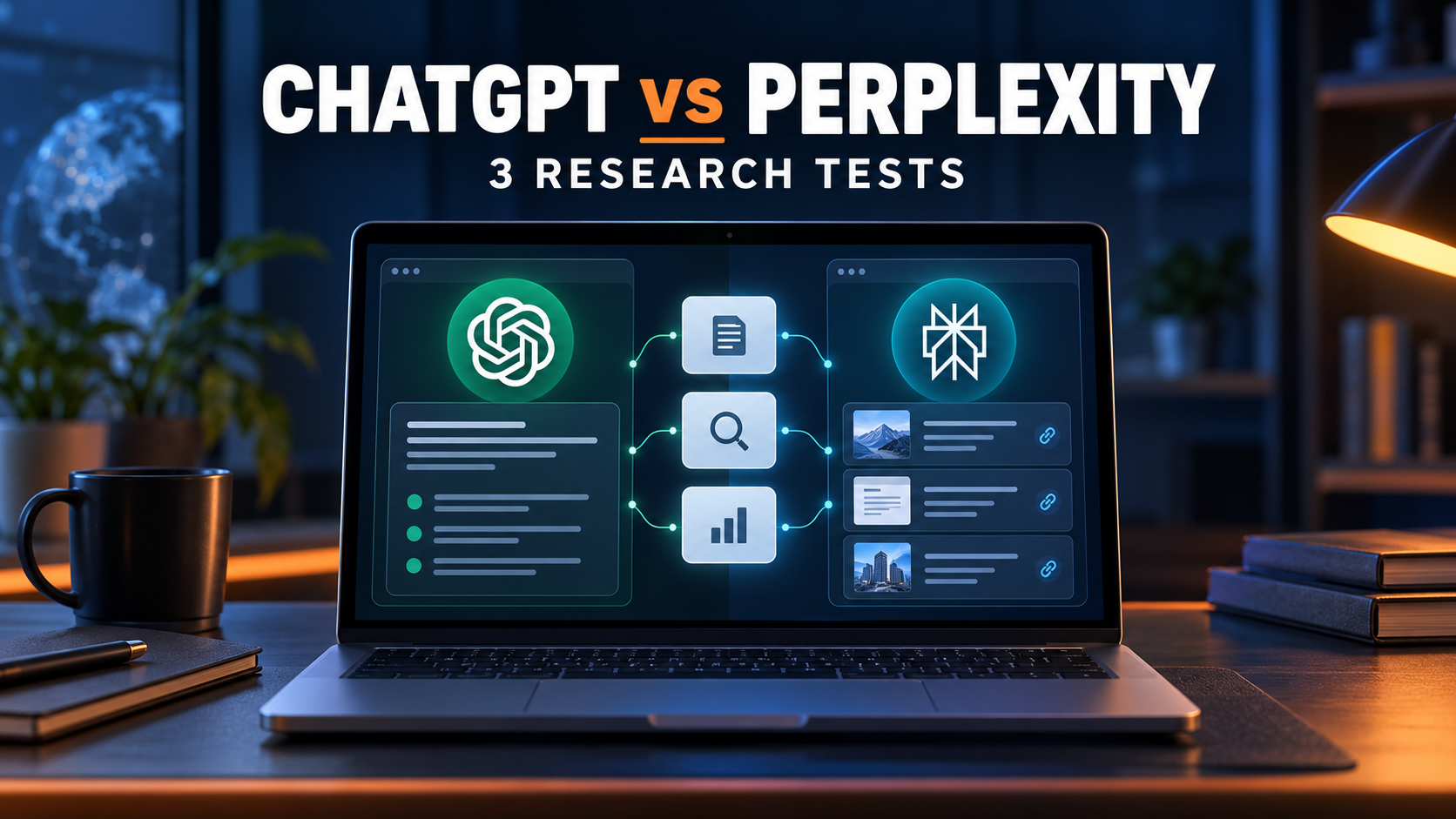
ChatGPT and Perplexity can both search the web, cite sources, analyze information, and turn research into a readable answer. That makes the comparison look simple until you inspect the work behind the response.
Did the tool find the right primary source? Did the link open the page it claimed to cite? Did the source actually support the sentence beside it? Could the tool combine several sources without quietly losing an important qualification?
We tested those questions directly. We gave the free versions of ChatGPT and Perplexity the same three research tasks, using standard web search rather than either product’s Deep Research mode. The topic was the EU AI Act because it requires current information, date-sensitive legal interpretation, reliable primary sources, and careful synthesis.
The result was not a clean sweep.
ChatGPT vs Perplexity for Research: Quick Verdict
Perplexity won the overall comparison. It won two of the three tests and averaged 8.3/10, compared with 7.4/10 for ChatGPT.
Perplexity was the better research starting point because its citations were easier to see, open, and audit. In our citation test, it supplied direct official URLs and specific supporting sections more consistently.
ChatGPT was better at deeper interpretation. It chose a slightly stronger source set in the first test and produced the more legally precise synthesis in the third. Its main problem was not weak reasoning. It was traceability: the copied answers repeatedly showed source labels instead of the direct URLs the prompt explicitly required.
| Research need | Better choice | Why |
|---|---|---|
| Finding sources quickly | Perplexity | Citations and links are central to the answer |
| Auditing whether a source supports a claim | Perplexity | Direct URLs and source placement were easier to inspect |
| Synthesizing complex evidence | ChatGPT | More precise distinctions and stronger practical reasoning |
| Producing a polished research brief | ChatGPT | Better at turning evidence into a structured deliverable |
| Starting broad web research | Perplexity | Faster source-first workflow |
| Developing a conclusion after verification | ChatGPT | Stronger analytical second stage |
| Best single tool for our three tests | Perplexity | Won citation accuracy and overall average |
Best for source-first research: Perplexity
Best for analysis and synthesis: ChatGPT
Best overall in this test: Perplexity
This does not mean Perplexity is always more accurate. In our first test, several of its source dates and descriptions were wrong even though the links were visible. A visible citation is easier to verify; it is not automatic proof that the answer represented the source correctly.
For a wider comparison of research products rather than these two general assistants, see our guide to the best AI tools for research.
How We Tested ChatGPT and Perplexity
We used three identical tasks:
- Source discovery: find five current, authoritative EU sources and explain what each could verify.
- Citation accuracy: judge six claims about the EU AI Act and support every verdict with a direct official source and exact section.
- Research synthesis: turn the evidence into an executive compliance brief for a 50-employee EU software company.
Both tools were tested on their free/default experiences with normal web search. We did not use ChatGPT Deep Research or Perplexity Research. Paid research modes are discussed separately because comparing a free standard search in one product with a premium autonomous report in the other would not be a fair test.
We scored each response on:
- source authority;
- factual and metadata accuracy;
- citation visibility and traceability;
- instruction-following;
- completeness;
- synthesis quality;
- practical usefulness.
The prompts, source requirements, and evaluation standard were the same for both products. That is consistent with how Toolytica reviews tools: we compare the same task, check the original source, and separate fluent presentation from factual reliability.
One limitation matters. Product interfaces can render citations differently from copied text. Our scores reflect the complete outputs available for review, including whether the requested direct URLs remained visible in those outputs. A citation that existed only as an interface element may be more usable inside the live chat than in an exported or pasted answer.
Test Results at a Glance
| Test | ChatGPT | Perplexity | Winner |
|---|---|---|---|
| Source discovery | 7.2/10 | 7.0/10 | ChatGPT |
| Citation accuracy | 7.5/10 | 9.8/10 | Perplexity |
| Research synthesis | 7.6/10 | 8.1/10 | Perplexity |
| Average | 7.4/10 | 8.3/10 | Perplexity |
These scores measure the submitted answers to our three prompts. They are not permanent product ratings and should not be interpreted as a claim that one assistant is more accurate for every topic.
Test 1: Finding the Right Official Sources
The first task asked each tool to find five primary, official EU sources that could establish the AI Act rules and application dates in force on September 21, 2026. We required a table containing the source title, publisher, publication or update date, direct URL, and what the source could verify. The prompt also required exactly three sentences explaining limitations.
What ChatGPT Did Better
ChatGPT assembled the stronger source set.
It included:
- the current consolidated AI Act text;
- Regulation (EU) 2026/1744, which amended the timetable;
- the European Commission’s AI Act overview;
- the Commission’s enforcement framework;
- the AI Act Service Desk’s implementation guidance.
Including the amending regulation was particularly useful. It gave the answer a direct legal basis for the new dates rather than relying only on a policy summary.
ChatGPT also described the role of each source sensibly. It distinguished the binding regulation from implementation overviews and enforcement guidance, which is exactly what a careful researcher should do.
Where ChatGPT Fell Short
The direct URL column did not preserve visible URLs in the reviewed answer. It displayed citation-style labels such as “EUR-Lex” and “European Commission” instead. That created unnecessary work: the source names were strong, but the reader still had to reconstruct or reopen the citations.
ChatGPT also ignored the instruction to end with exactly three limitation sentences.
This is a recurring research issue. An answer can be substantively strong and still fail as a reusable research artifact if the evidence trail does not survive copying into a document, email, or content-management system.
What Perplexity Did Better
Perplexity displayed five direct official URLs. A reader could immediately open the EUR-Lex and European Commission pages without rebuilding the source list.
That is Perplexity’s core advantage: it behaves like a search product first. The source trail is normally part of the answer rather than an optional layer added afterward.
Where Perplexity Fell Short
Several source descriptions or dates were inaccurate:
- It described an EUR-Lex legal-summary page as the full binding text.
- It assigned an unsupported date to the AI Act Service Desk timeline.
- It gave June 19, 2026 as the last-update date for the Commission AI Act overview, while the page showed August 3, 2026 when checked.
- It treated November 5, 2025 as the final publication date of the transparency code, although that date referred to the code’s launch process; the final code was published on June 10, 2026.
Perplexity also omitted the required three limitation sentences.
Test 1 Verdict
ChatGPT won narrowly, 7.2 to 7.0.
Perplexity made the sources easier to open, but ChatGPT chose and characterized the legal source set more carefully. This test shows why citation presence and citation accuracy must be scored separately.
Test 2: Checking Claims and Citations
The second task contained six claims about when different AI Act obligations applied. Each tool had to label every claim True, False, or Misleading, correct it where necessary, provide a direct official URL, and identify the exact article, section, or page heading supporting the verdict.
Both tools got the six substantive verdicts right.
The claims covered:
- the general application date of the AI Act;
- general-purpose AI obligations;
- Article 50 transparency requirements;
- December 2026 prohibitions concerning specified intimate material and child sexual abuse material;
- the December 2027 date for Annex III high-risk systems;
- the August 2028 date for high-risk systems embedded in regulated products.
Why Perplexity Won Clearly
Perplexity supplied a complete, visible official URL for each claim and named the supporting heading. The reader could move from verdict to evidence with minimal friction.
Its main weakness was small: the correction to the first claim emphasized the provisions that applied earlier than August 2026 but did not explain the later high-risk dates as fully as ChatGPT did.
ChatGPT’s corrections were often more complete. It distinguished the general application date from provisions applying both earlier and later, and it used the consolidated regulation precisely. However, its source column again showed citation labels rather than visible direct URLs. The sixth row was also incomplete in the reviewed copy, so the final citation could not be fully confirmed.
Test 2 Verdict
Perplexity won 9.8 to 7.5.
This was the most decisive result of the comparison. When the job is to create an auditable claim-to-source table, Perplexity’s visible citation workflow is a major practical advantage.
Test 3: Turning Research Into an Executive Brief
The final task asked each product to produce a 700–900-word executive brief for a 50-employee EU software company developing a customer-service chatbot and a generative-image tool.
The brief had to explain:
- obligations already applicable;
- upcoming compliance dates;
- the difference between provider and deployer roles;
- five priority actions;
- limitations and unknown facts;
- exactly five official sources;
- a direct official URL supporting every paragraph.
ChatGPT Produced the Better Legal Analysis
ChatGPT made several useful distinctions that Perplexity handled less precisely.
It explained that the same company can be a provider when it places its own system on the market and a deployer when it uses an AI system under its authority. It separated the provider’s machine-readable marking duty for synthetic content from a deployer’s visible disclosure duty when an output qualifies as a deepfake.
It also correctly warned that merely integrating another company’s general-purpose model does not automatically make the software company the provider of that underlying model.
The recommendations followed logically from the facts: classify each system, implement chatbot and image-transparency controls, prepare for the December 2026 prohibitions, document AI-literacy measures, and create a conditional workstream for any high-risk or general-purpose-model obligations that genuinely apply.
Perplexity Produced the More Auditable Brief
Perplexity’s brief was easier to verify because the official URLs were visible throughout the response and repeated in a final source list.
Its structure was clear, the important dates were correct, and it appropriately avoided claiming that every chatbot or image generator is automatically high-risk.
However, some statements were broader than the cited source clearly established. For example, it said a customer deploying the chatbot “must not remove or obscure” the disclosure, but the nearby source did not directly support that exact formulation. It also presented controls involving impersonation, evasion, and retention in a way that could be read as explicit AI Act requirements, although they were better understood as risk-management recommendations.
The first priority action lacked a direct citation, and the final source list included sources that were not clearly used in the body. Its EUR-Lex link also pointed to the original 2024 text rather than clearly identifying the current consolidated version that reflected the 2026 amendments.
Both Tools Missed One Instruction
Both briefs exceeded the requested 900-word ceiling.
This is important for real client work. A model can be accurate and still create editing costs by ignoring a delivery constraint. Research quality includes following the requested format, length, and evidence standard—not only getting the conclusion right.
Test 3 Verdict
Perplexity won narrowly, 8.1 to 7.6.
ChatGPT produced the stronger reasoning, but Perplexity delivered the more transparent evidence trail. If the prompt had weighted legal nuance more heavily than direct-link compliance, ChatGPT could reasonably have won this test.
The Real Difference: Research Interface vs General AI Workspace
Perplexity is built around retrieval. A question normally produces a concise answer with numbered sources, and the user is encouraged to inspect the evidence immediately. That makes it efficient for collecting sources, checking current facts, and following a research trail.
ChatGPT is a broader workspace. Search is one capability among writing, file analysis, data work, image generation, projects, coding, and extended reasoning. It is more natural when research is only the first step and the real deliverable is a report, decision memo, spreadsheet, plan, or polished article.
That distinction explains our results.
Perplexity was better when the output needed to expose its source structure. ChatGPT was better when the output needed to reason across roles, exceptions, conditions, and practical next steps.
If your choice is broader than research, our ChatGPT vs Claude comparison examines writing, files, coding, prompt-following, and everyday platform features in more detail.
ChatGPT vs Perplexity: Features That Matter for Research
| Feature | ChatGPT | Perplexity |
|---|---|---|
| Standard web search | Available on Free and paid plans | Core feature of Free and paid plans |
| Citation presentation | Citations may appear in searched answers; source visibility can vary by response/export | Inline citations are central to normal answers |
| Deep research mode | Available with plan-dependent limits | Research mode available with plan-dependent limits |
| Source controls | Deep Research can prioritize or restrict specific sites | Strong source-first workflow; paid plans add broader research access and data sources |
| File analysis | Available with plan-dependent limits | Limited on Free; higher limits on paid plans |
| Projects | Useful for keeping chats, files, and instructions together | Projects organize searches and can hold files; Pro supports up to 50 files per project |
| Model choice | Depends on plan and current model access | Paid plans can select supported advanced models; Free uses automatic selection |
| Writing and synthesis | Strong, especially when building a finished deliverable | Good summaries, but research traceability is the stronger differentiator |
| Exportable research reports | Deep Research reports can be downloaded in formats including Markdown, Word, and PDF | Research workflows emphasize cited reports; current options depend on the product surface and plan |
OpenAI explicitly warns that search citations can be incomplete, outdated, or incorrect and recommends opening the source and checking whether it supports the claim. That warning should be applied to both products.
Free Plans: Which One Is Better for Research?
For quick web research, Perplexity Free is the better starting point.
Its current Standard plan includes practically unlimited basic searches, automatic model selection, limited file uploads, three Pro Searches per day, and one Research query per month. The exact interface and limits can change, but those were the figures in Perplexity’s official plan comparison when checked on September 22, 2026.
ChatGPT Free also supports web search and offers a much broader general-purpose workspace. It is useful when the same session may move from finding information to writing, analysis, files, images, or planning. OpenAI does not promise one fixed universal limit for every feature; its Free Tier documentation says models and usage limits can change over time.
Choose Perplexity Free if your main action is:
- ask a question;
- inspect the cited sources;
- refine the search;
- collect evidence.
Choose ChatGPT Free if your workflow is:
- research a topic;
- question the evidence;
- restructure the findings;
- create a finished document or plan.
For important work, the better free workflow may be to use both: Perplexity for initial retrieval, then ChatGPT for synthesis, followed by a manual check of every claim you plan to publish.
Paid Plans and Research Value
The most relevant individual comparison is ChatGPT Plus vs Perplexity Pro.
| Plan | Official US price checked | Research-relevant value |
|---|---|---|
| ChatGPT Free | $0 | Web search and limited access to files and research tools |
| ChatGPT Plus | $20/month | Higher limits, file analysis, advanced reasoning, and Deep Research where available |
| ChatGPT Pro 5X | $100/month | Pro features with five times the Plus usage allowance |
| ChatGPT Pro 20X | $200/month | Highest individual usage tier, but new sign-ups and upgrades were paused as of September 10, 2026 |
| Perplexity Standard | $0 | Basic searches, 3 Pro Searches/day, 1 Research query/month, limited uploads |
| Perplexity Pro | $20/month or $200/year | Extended Pro Search and Research access, advanced model choice, higher upload limits, up to 50 files per project |
| Perplexity Max | $200/month or $2,000/year | Higher limits, advanced models, and early access for sustained heavy use |
Prices can vary by region, tax, platform, promotion, and account eligibility. Check the amount and renewal terms shown at checkout.
When ChatGPT Plus Is Better Value
Choose ChatGPT Plus if research is one part of a mixed workflow. Its value is broader than search: advanced reasoning, file analysis, writing, images, data tasks, and other tools live in the same account.
It is the more defensible $20 purchase for someone who wants one AI subscription for research plus content production, planning, document work, or analysis.
When Perplexity Pro Is Better Value
Choose Perplexity Pro if source discovery is frequent enough that the Free limits interrupt your work.
Pro increases research and upload capacity, adds advanced model selection and premium data sources, and keeps the product centered on evidence retrieval. The annual option costs $200 upfront, which is cheaper than twelve separate $20 monthly payments, but only makes sense if you expect to use it throughout the year.
Do not upgrade simply because the paid answer may sound more authoritative. Upgrade when you repeatedly hit a real limit: research queries, file uploads, model access, or sustained source-heavy work.
Privacy and Sensitive Research
Neither consumer product should be treated as the automatic destination for confidential client files, unpublished research, legal records, health data, or proprietary company information.
For consumer ChatGPT plans, OpenAI says eligible content may be used to improve its models unless the user turns off Improve the model for everyone under Data Controls. Temporary chats are not used to improve models while they remain temporary, although OpenAI says they may be retained for up to 30 days for safety purposes.
Perplexity’s consumer plans offer an AI Data Usage control that allows users to opt out of their search data being used to improve AI models. Perplexity’s plan comparison says Enterprise data is not used for model training; consumer and enterprise terms should not be treated as interchangeable.
The practical rule is simple:
- turn off model-improvement settings before sensitive work;
- avoid uploading information you are not authorized to share;
- use an appropriate business or enterprise agreement when contractual privacy, retention, administrative controls, or regulatory obligations matter;
- review connected-source permissions before allowing either tool to search private drives or applications.
An opt-out reduces one category of data use. It does not turn a consumer account into a regulated document-management system.
Which Tool Should You Choose?
Choose Perplexity If You Are a Student Starting Research
Perplexity makes the source trail visible early. That is useful for moving from a broad question to original papers, government pages, or official documentation.
Do not cite the Perplexity answer itself. Open the source, read the relevant passage, and cite the original work according to your institution’s rules.
Choose Perplexity If You Are a Journalist or Fact-Checker
The citation-first interface is efficient for locating current sources and comparing coverage. It also makes weak evidence easier to spot because the link is close to the claim.
However, our first test proves that metadata still needs checking. A direct link can be real while its date, title, or description is wrong.
Choose ChatGPT If You Are a Consultant or Analyst
ChatGPT is better suited to the second half of the job: turning verified sources into a brief, option analysis, action plan, presentation outline, or client-ready narrative.
Use a source table before drafting and require the final document to preserve direct links. Otherwise, good reasoning can become difficult to audit after export.
Choose ChatGPT If Research Feeds Into Writing
When the outcome is an article, report, email sequence, policy draft, or structured document, ChatGPT’s broader workspace is valuable. It can challenge the outline, identify missing assumptions, and reshape the evidence for a defined audience.
That initiative is useful only after the evidence is stable. Do not let a polished rewrite introduce claims that were absent from the verified source set.
Use Both If Accuracy Matters More Than Convenience
A practical two-tool workflow is:
- Ask Perplexity to find primary sources and expose the citations.
- Open every source that supports a material claim.
- Build a short evidence table containing the claim, supporting passage, date, and URL.
- Give that verified evidence to ChatGPT for synthesis.
- Recheck the final draft against the evidence table.
Using two tools does not create independent confirmation if both repeat the same incorrect webpage. The confirmation comes from reading the original evidence.
Common Research Mistakes With Both Tools
Treating a Citation as Proof
A citation shows where the tool looked. It does not prove that the source supports the nearby sentence.
Accepting Source Metadata Without Opening the Page
Dates, titles, publishers, and document types are easy for an assistant to misstate. Our Perplexity source-discovery result contained several such errors.
Mixing Original and Consolidated Legal Texts
For laws that have been amended, an original regulation and a current consolidated text are not interchangeable. Check the version date and subsequent amendments.
Comparing Different Modes
Standard search, Pro Search, Research, and Deep Research are different workflows with different limits and depth. Record the mode used when evaluating a result.
Giving One Tool a Better Prompt
A fair comparison requires the same prompt, source restrictions, date, files, and output format.
Asking for Too Much in One Pass
Separate retrieval, verification, and writing when accuracy matters. A single prompt that asks the model to find, validate, interpret, and publish can hide where an error entered the process.
Final Verdict: Perplexity Wins Research, ChatGPT Wins the Next Step
Perplexity is the better choice for most people whose first priority is finding and checking web sources. It won two of our three tests, produced the clearest citation trail, and required less effort to move from a claim to an official page.
ChatGPT is the better analytical workspace once the evidence has been gathered. It selected a stronger source set in our first test and produced the more precise legal synthesis in our third. Its weakness was operational: the requested direct URLs did not consistently survive in the answer we reviewed.
Our recommendation is therefore use-case specific:
- Choose Perplexity for source discovery, current fact-finding, and citation-heavy web research.
- Choose ChatGPT for interpreting verified evidence and turning it into a polished, actionable deliverable.
- Use both for high-stakes research, but verify the original sources yourself.
If you want only one free tool for research, start with Perplexity. If you want one paid AI subscription that must also handle writing, files, analysis, images, and broader knowledge work, ChatGPT Plus is the more versatile purchase.
Frequently Asked Questions
Is Perplexity Better Than ChatGPT for Research?
Perplexity was better overall in our three research tests because it made direct sources easier to inspect and won the citation-accuracy test decisively. ChatGPT produced stronger analysis in parts of the comparison, so the best choice depends on whether you prioritize retrieval or synthesis.
Is ChatGPT or Perplexity More Accurate?
Neither is reliably more accurate for every topic. Perplexity can show a real link while misstating its date or meaning, and ChatGPT can produce strong reasoning without preserving a clear citation trail. Accuracy still requires opening the original source.
Which Is Better for Academic Research?
Perplexity is a convenient starting point for finding sources, but neither product replaces a dedicated scholarly database or systematic-review workflow. For peer-reviewed research, use appropriate academic databases and verify the full paper rather than relying on an AI summary.
Can I Trust Perplexity Citations?
Trust them as leads, not as proof. Check that the page is the claimed source, that it is current, and that it supports the exact sentence attached to the citation.
Does ChatGPT Provide Sources?
ChatGPT can search the web and include citations. OpenAI itself warns that search results and citations may be incomplete, outdated, or incorrect, so important claims should be checked against authoritative sources.
Is Perplexity Pro Worth It Over the Free Plan?
It is worth considering when you consistently hit Free limits or need frequent Research queries, advanced model selection, premium sources, or higher file-upload capacity. Occasional users should test Standard first.
Is ChatGPT Plus Worth It for Research?
ChatGPT Plus is strongest for users who combine research with writing, file analysis, planning, or other AI tasks. If your work is almost entirely source discovery, Perplexity Pro may be the more focused purchase at the same $20 monthly price.
Can I Use ChatGPT and Perplexity With Confidential Documents?
Consumer accounts require caution. Disable model-improvement settings, review retention and connected-app permissions, and do not upload data you are not authorized to share. Organizations with contractual or regulatory requirements should evaluate the relevant business or enterprise plan rather than assuming consumer settings are sufficient.