Quick Verdict
Most people reaching for an AI research tool aren’t trying to replace their own judgment — they’re trying to cut down the hours spent finding, reading, and cross-checking sources before they trust an answer enough to use it.
For that job, our recommendations are:
| What You Need | Best Choice |
|---|---|
| General web research with live, numbered citations | Perplexity |
| Peer-reviewed academic literature and evidence synthesis | Consensus |
| Structured systematic reviews and data extraction across papers | Elicit |
| Chatting with your own uploaded PDFs specifically | See our PDF.ai review below |
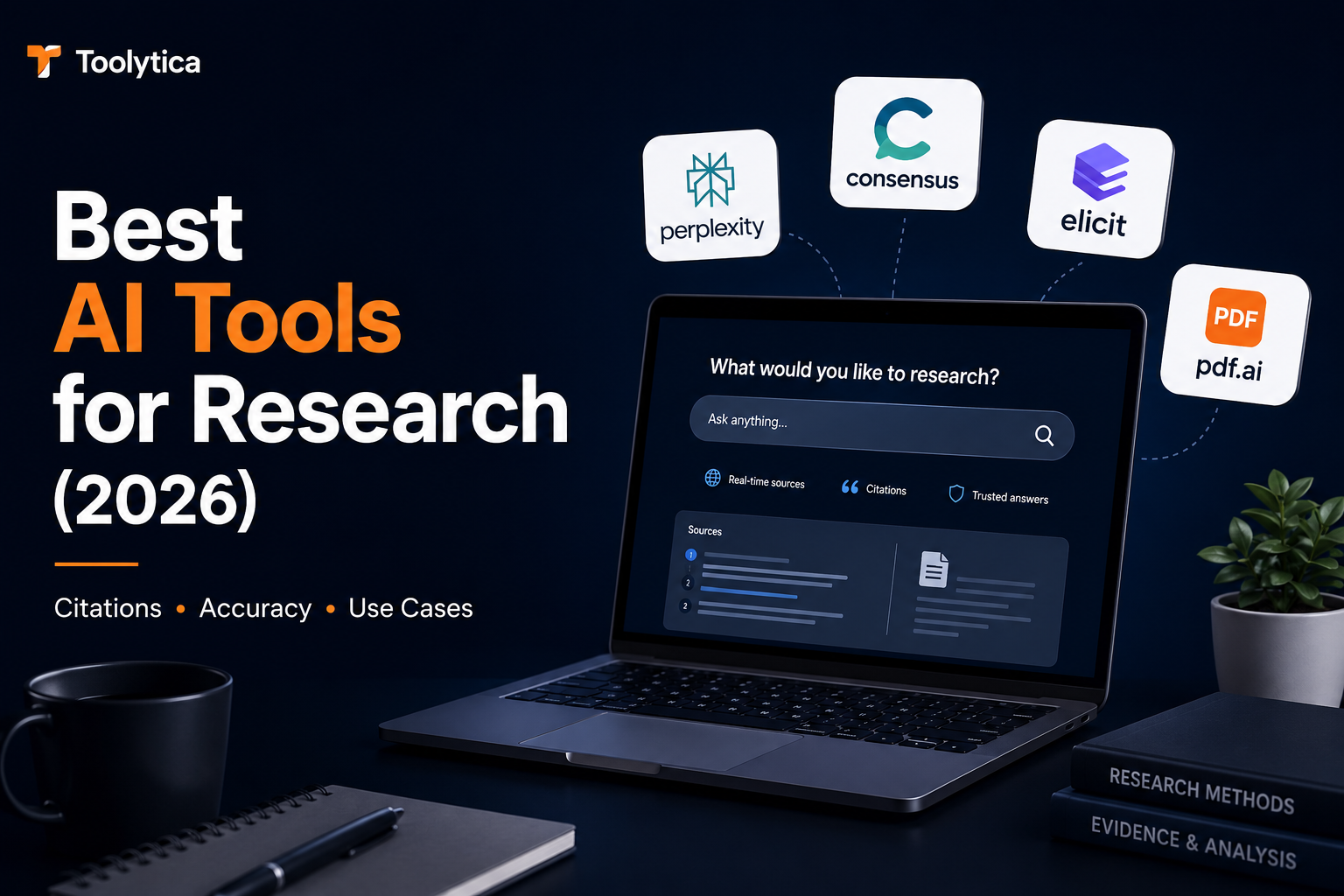
Perplexity is the strongest general-purpose research tool, pulling from the live web with citations attached to every claim.
Consensus is built specifically for peer-reviewed scientific literature, with a distinctive Consensus Meter showing how much studies actually agree.
Elicit is the deepest option for structured literature reviews — data extraction into tables rather than prose summaries.
Citations Are Not the Same as Accuracy
This is the distinction that “AI research tool” marketing tends to blur.
A citation tells you where a claim supposedly came from. Accuracy tells you whether the tool actually represented that source correctly. These tools are good at the first job and meaningfully imperfect at the second — every one of them can misread a paper’s conclusion, oversimplify a nuanced finding, or occasionally cite a source that doesn’t actually support the claim attached to it.
The practical implication: treat the citation as a starting point for verification, not proof the claim is correct. The tools that make this easiest — letting you click straight through to the original paper or page — are doing more for your actual accuracy than the tools that just look more confident.
How We Evaluated These AI Research Tools
This guide separates verified product information from editorial recommendations.
Prices, plan limits, database sizes, and product features were checked against the providers’ official pricing and help pages on September 29, 2026. When an official page did not publish a stable numerical limit, we did not substitute an estimate from a third-party website.
The tools were compared around five practical research needs:
- Finding current information from the open web
- Discovering peer-reviewed academic papers
- Tracing an answer back to its original source
- Comparing findings across several papers
- Working with uploaded documents or PDFs
This article does not assign a universal numerical accuracy score. We did not find a current independent benchmark that evaluates Perplexity, Consensus, and Elicit across the same prompts, subjects, source sets, and verification rules. Recommendations are therefore based on source traceability, documented features, workflow fit, current limits, and the limitations each provider discloses.
Best AI Tools for Research: The Fast Decision
Choose Perplexity when your research spans the open web — news, documentation, general topics — and you want fast, cited answers.
Choose Consensus when your question is specifically about what peer-reviewed science says, and you want to see the degree of agreement across studies, not just one AI’s summary.
Choose Elicit when you’re doing a structured literature review or need data extracted into a comparable table across many papers, not a narrative answer.
Choose a dedicated PDF tool — not a general research assistant — when the job is specifically chatting with documents you already have, rather than finding new sources.
Perplexity: Best for General Web Research With Citations
Perplexity is the strongest fit in this guide for broad research across the live web. It produces source-linked answers and allows users to open the cited pages instead of relying only on the generated summary.
The Standard plan includes practically unlimited basic searches, a very limited number of Pro Searches, and limited file uploads. Perplexity Pro currently costs $20 per month or $200 per year and provides extended access to Pro Search and Research, advanced model selection, and higher limits for file analysis and other premium features.
Perplexity supports PDFs, text files, images, audio, video, and code files. However, its official documentation states that long files may be processed by extracting the sections considered most relevant rather than analyzing every part equally. Important claims should therefore still be checked against the original document.
Official sources: Perplexity plans, Perplexity Pro, and Perplexity file uploads.
Perplexity Is Best For
- General research spanning the open web, not just academic papers
- Quick, cited answers to time-sensitive or current-events questions
- Uploading your own PDFs into a broader research conversation
Consensus: Best for Academic and Peer-Reviewed Literature
Consensus is designed specifically for questions that need to be grounded in scientific literature rather than the general web. Its official research database currently contains more than 220 million peer-reviewed papers and is updated weekly.
The product searches sources including Semantic Scholar, OpenAlex, publisher partnerships, and Consensus’s own scholarly-web crawl. When full text is available, Consensus can analyze sections beyond the abstract, including methods, results, and discussion.
The Consensus Meter is useful for yes-or-no research questions, but it should not be interpreted as a complete scientific consensus. According to Consensus, the Meter normally uses between 5 and 20 of the most relevant papers returned for a query. Consensus also acknowledges that the model can occasionally classify a result incorrectly or overlook important nuance.
The current individual plans are:
- Free: 15 Pro messages and up to 3 Deep reviews per month
- Pro: $20 per month or $144 per year, including unlimited Pro messages and 15 Deep reviews per month
- Deep: $65 per month or $540 per year, including 200 Deep reviews per month
Consensus is best used to identify relevant papers, understand the broad direction of published evidence, and open the studies behind an answer. It should not replace reading the original methods, results, and limitations of any paper used in important work.
Official sources: Consensus subscription plans, Consensus research database, Deep review limits, and Consensus Meter limitations.
Consensus Is Best For
- Questions specifically about what peer-reviewed research concludes
- Getting a fast sense of scientific agreement or disagreement on a topic
- Researchers, clinicians, and students who need citations tied to individual studies
Elicit: Best for Structured Literature Reviews and Evidence Tables
Elicit is the strongest fit when the research task requires structured screening, comparison, or extraction across multiple papers rather than a single narrative answer.
Its Basic plan currently provides unlimited search across more than 138 million papers, unlimited paper summaries, source visibility, Zotero import, and unlimited chat with papers when full text is available. Access to Research Agent and Research Reports is limited on the free plan.
For academic users, Elicit’s current annual pricing shows:
- Basic: Free
- Plus: $11 per user per month, billed as $132 annually
- Pro: $39 per user per month, billed as $468 annually
- Scale: $89 per user per month, billed as $1,068 annually
Plus adds exports in formats including RIS, CSV, BIB, PDF, and DOCX. Pro adds higher advanced-workflow usage, a dedicated systematic-review workflow that can screen up to 5,000 papers, more extraction columns, custom extraction from uploaded papers, and API access.
Elicit is most valuable when the researcher needs to build an evidence table containing fields such as study design, population, sample size, intervention, outcome, and limitations. Its structured workflow makes comparisons easier to inspect, but the extracted information should still be checked against the original paper.
Official source: Elicit pricing.
Reading and Chatting With Your Own PDFs
If your actual task is chatting with documents you already have — a lecture PDF, a contract, a personal research file — rather than discovering new sources, a dedicated PDF assistant is a better fit than a general research tool. See our full PDF.ai Review for how that compares specifically for summarizing and querying your own uploaded PDFs.
Accuracy and Source Limitations You Should Know
A real citation does not automatically make an AI-generated statement correct. The source may exist while the summary misrepresents its population, methods, findings, or limitations.
Perplexity can provide fast access to current web sources, but its documentation explains that long uploaded files may be reduced to the sections considered most relevant. A detail outside those extracted sections can therefore be missed.
Consensus provides traceable academic citations, but its own documentation warns that the Consensus Meter covers only a limited set of the most relevant results and can occasionally classify a paper incorrectly or overlook nuance.
Elicit provides supporting sources and structured extraction, but its published evaluations do not prove identical performance in every field. Elicit notes that some evaluations relied on open-access literature, specific research domains, or limited samples, and that the findings may not generalize to every discipline or review design.
Use this verification sequence for any important claim:
Cite the original source rather than the AI-generated answer.
Open the original cited source.
Locate the exact supporting passage.
Check the population, method, date, and outcome.
Confirm that the AI statement does not go beyond the source.
Check for corrections, retractions, or more recent evidence.
If your work focuses specifically on academic papers, citations, and literature reviews, compare the best AI tools for research papers.
Pricing at a Glance
Prices and published limits were verified on official provider pages on September 29, 2026. Prices are shown in US dollars before tax. Regional pricing and checkout totals may differ.
| Tool | Useful Free Access | Paid Entry Point | Published Research Allowance | Main Caveat |
|---|---|---|---|---|
| Perplexity | Practically unlimited basic searches, very limited Pro Searches, and limited file uploads | Pro: $20/month or $200/year | Extended access to Pro Search and Research | No fixed daily Research allowance is currently guaranteed |
| Consensus | 15 Pro messages and up to 3 Deep reviews per month | Pro: $20/month or $144/year | Pro includes 15 Deep reviews per month; Deep includes 200 | The $12/month equivalent requires annual payment of $144 |
| Elicit | Unlimited search across 138M+ papers, unlimited summaries, source visibility, and limited advanced workflows | Plus: $11/user/month, billed $132 annually | Usage depends on the selected workflow and plan | The $11 figure is an annual-billing equivalent |
Always check the provider’s current checkout page before paying, especially when billing frequency, country, taxes, or customer type can change the displayed price.
Common Mistakes When Using AI Research Tools
Treating a Citation as Proof
A linked source means the tool found something related — not that it represented that source’s conclusion correctly. Open the actual paper for any claim you plan to rely on.
Using a General Tool for a Systematic Review
Perplexity and Consensus are built for fast answers, not side-by-side structured comparison across dozens of studies. That’s Elicit’s job.
Treating Web Search as a Complete Literature Review
A general web-research tool can surface academic papers, but that does not make the search comprehensive or reproducible.
Use Perplexity for broad research across the web. Use Consensus when the question depends specifically on peer-reviewed findings. Use Elicit when the task requires structured screening, extraction, or comparison across a defined paper set.
Skipping the Free Tier Before Paying
All three free tiers are capable enough to test whether the tool actually fits your research style before you commit to a monthly cost.
What These Tools Can’t Do For You
They don’t replace subject-matter judgment about which studies are actually well-designed versus merely published. They don’t guarantee a synthesized answer reflects nuanced disagreement within a field. And they don’t remove the responsibility to verify a specific claim before you cite it in your own work — a faster route to sources is not the same as a substitute for reading them.
Setups I Would Actually Recommend
For General Research and Journalism
Use Perplexity Free for basic day-to-day research. Consider Pro when the free plan’s current Pro Search, Research, model-selection, or file-analysis limits repeatedly interrupt your workflow.
For Academic and Clinical Research
Use Consensus for evidence-based questions with a clear yes/no framing, and verify pricing directly given its recent restructuring.
For Systematic Reviews and Evidence Synthesis
Use Elicit, specifically for its structured data extraction across many papers rather than a single narrative answer.
For Students on a Budget
Start with the free tiers before paying for a subscription. Perplexity currently offers Education Pro to verified students and educators, but eligibility and pricing should be checked directly before subscribing. We could not confirm a current public student discount for Consensus from its official pricing documentation.Start with the free tiers of all three before paying for anything — each one is capable enough to evaluate fit, and Perplexity and Consensus both offer discounted student pricing once you do need to upgrade.
Final Recommendation
There’s no single best AI research tool — the right one depends on whether your question is general, specifically academic, or requires structured comparison across studies.
Choose Perplexity for broad, cited research across the open web.
Choose Consensus for peer-reviewed questions where scientific agreement itself is part of the answer.
Choose Elicit for systematic reviews needing structured, comparable data across papers.
My recommendation for most people starting out: try Perplexity’s free tier first for general questions, and reach for Consensus specifically when the question is “what does the actual research say” rather than “what’s true in general.” Verify any claim that matters before you rely on it, regardless of which tool produced it.
FAQ
What Is the Best AI Tool for Academic Research?
Consensus is built specifically for peer-reviewed literature and shows scientific agreement via its Consensus Meter. Elicit is the better fit if you need structured data extraction across many papers for a systematic review.
Can I Trust the Citations These AI Tools Provide?
The citations are generally real and clickable, but the summary attached to them can occasionally misrepresent what the source actually concluded. Verify any claim you plan to rely on against the original source.
Do These Tools Hallucinate?
Yes, occasionally, particularly in how they synthesize findings across multiple sources rather than in fabricating citations outright. Independent reviews have specifically flagged this for Consensus, and the same risk applies to Perplexity and Elicit.
Can I Use These Tools to Chat With My Own PDFs?
Perplexity supports uploading your own PDFs into a research conversation, and Consensus lets you chat with an individual uploaded paper. For dedicated, deeper PDF-specific chat, see our PDF.ai review.
How Much Do These Tools Cost?
Perplexity Pro currently costs $20 per month or $200 per year.
Consensus Pro costs $20 per month or $144 per year. Its higher Deep plan costs $65 per month or $540 per year.
Elicit offers a free Basic plan. Its academic Plus plan is shown at $11 per user per month when $132 is billed annually, while Pro is shown at $39 per user per month when $468 is billed annually.
These prices were checked on official provider pages on September 29, 2026. Taxes, regional pricing, customer type, promotions, and monthly billing options may change the final amount.
Are Free Plans Good Enough, or Do I Need to Pay?
For occasional research, the free plans are capable enough to evaluate each tool.
Paying makes sense when free-plan limits repeatedly interrupt your workflow or when you need higher Research allowances, advanced models, exports, structured evidence tables, or dedicated systematic-review features.
What’s the Biggest Limitation of AI Research Tools Overall?
Coverage gaps for unpublished or very recent research, and the fact that none of these tools reliably signal their own uncertainty — a confident-sounding answer isn’t necessarily a well-supported one.