Beehiiv vs ConvertKit: Which Newsletter Tool Is Better?
Beehiiv vs ConvertKit: The Short Answer
Beehiiv and ConvertKit can both send newsletters, collect subscribers, create landing pages, run automations, and sell digital products.
That overlap makes them look more interchangeable than they really are.
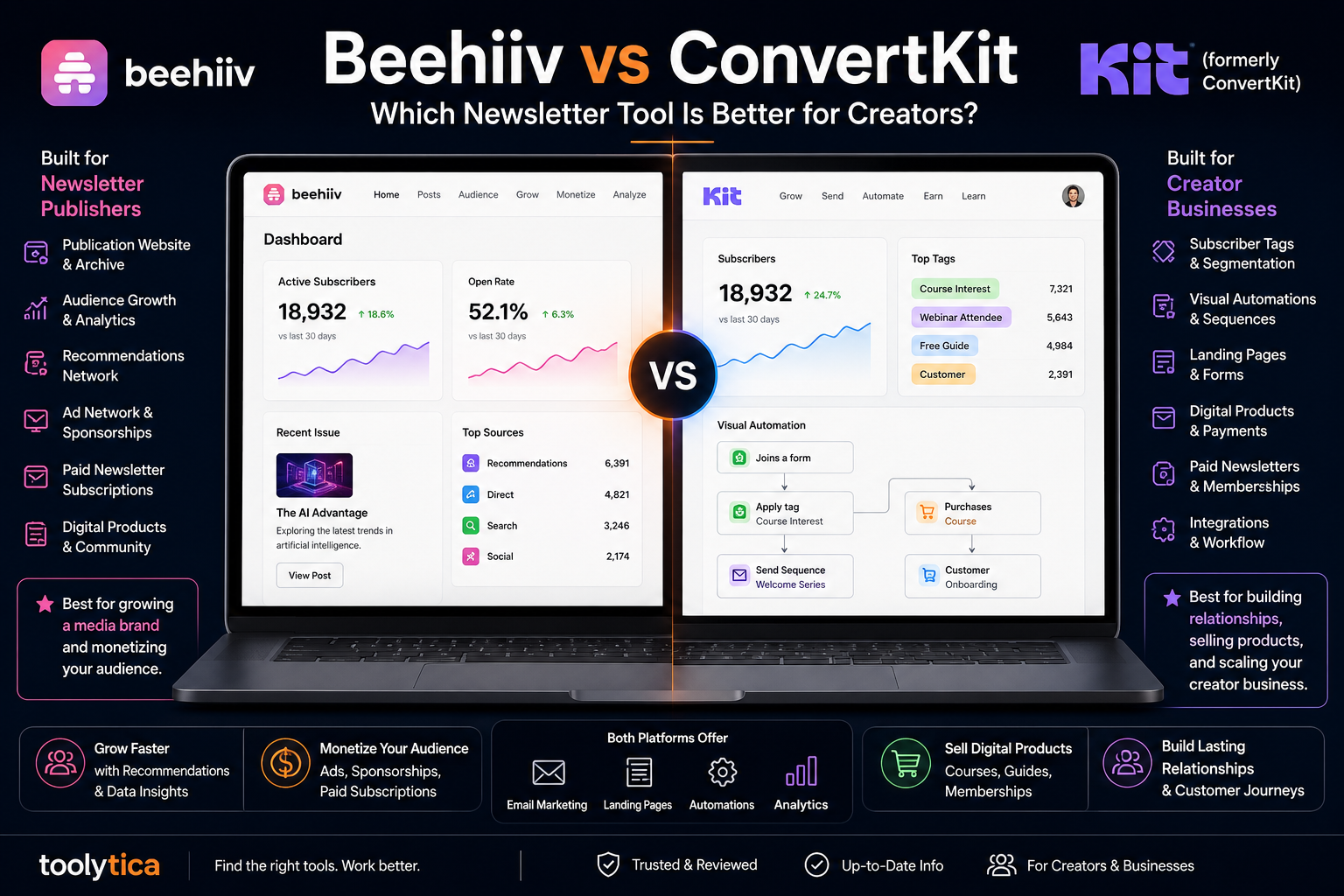
Beehiiv is built around the newsletter as a product. It feels natural for writers, niche publishers, media brands, and creators who want to grow a publication through recommendations, advertising, sponsorships, paid subscriptions, and a public content archive.
ConvertKit—now officially called Kit—is built around the subscriber relationship. It feels more natural when email supports courses, coaching, memberships, digital products, launches, lead magnets, and several different customer journeys. ConvertKit publicly rebranded to Kit, although the previous name remains widely used in searches and existing content.
The decision usually becomes clear with one question:
Is your newsletter becoming the business, or is it helping another business grow?
Beehiiv is generally the better fit when the newsletter itself is becoming the media property.
Kit is generally the better fit when the newsletter connects an audience to products, services, and automated sales journeys.
Our Practical Verdict
| What You Are Building | Better Fit |
|---|---|
| A newsletter-first publication | Beehiiv |
| A course, coaching, or digital-product business | Kit |
| A public newsletter website and archive | Beehiiv |
| Complex subscriber journeys | Kit |
| Advertising and sponsorship revenue | Beehiiv |
| Product launches and behavioral segmentation | Kit |
| The largest free subscriber allowance | Kit |
| The most complete free publishing setup | Beehiiv |
| Paid newsletters | Both |
| Several publications under one account | Beehiiv |
| Advanced customer-level email automation | Kit |
Best for newsletter publishers: Beehiiv
Best for broader creator businesses: Kit
The Part Most Comparisons Miss
Imagine two people starting a newsletter this week.
The first is writing a weekly cybersecurity briefing. The publication is the product. The plan is to attract thousands of readers, build a recognizable archive, recommend related newsletters, sell sponsorships, and eventually create a premium subscription.
The second person sells an online course. Their newsletter is important, but its job is different. It needs to deliver a lead magnet, tag subscribers by interest, run a welcome sequence, promote a webinar, identify buyers, and stop sending sales emails once someone purchases.
Both people need email software.
Only one of them needs a platform that behaves like a small media company.
Only one needs a platform that behaves like a customer-journey engine.
Beehiiv fits the first creator more naturally. Kit fits the second.
This difference matters far more than which platform has the nicer button style or one additional landing-page template.
Beehiiv vs ConvertKit Pricing in 2026
Both platforms charge according to subscriber count once you move beyond the free plan.
The following prices correspond to the 1,000-subscriber level and were checked on the official pricing pages in July 2026.
| Platform and Plan | Monthly Billing | Annual Billing Equivalent |
|---|---|---|
| Beehiiv Launch | Free | Free |
| Beehiiv Scale | $49/month | $43/month, billed $517 annually |
| Beehiiv Max | $109/month | $96/month, billed $1,151 annually |
| Kit Newsletter | Free | Free |
| Kit Creator | $39/month | $33/month, billed $390 annually |
| Kit Pro | $79/month | $66/month, billed $790 annually |
Beehiiv Launch remains free for up to 2,500 subscribers. At the 1,000-subscriber setting, Scale is shown at $43 per month with annual billing, while Max is $96 per month with annual billing. Beehiiv states that its paid plans start at $49 with flexible monthly billing.
Kit’s free Newsletter plan supports up to 10,000 unique active subscribers. For up to 1,000 subscribers, Creator costs $39 monthly or $390 annually, while Pro costs $79 monthly or $790 annually. Kit pricing increases as the number of active subscribers grows.
Which Paid Platform Is Cheaper?
At 1,000 subscribers, Kit Creator is less expensive than Beehiiv Scale.
That does not automatically make Kit the better value.
Beehiiv Scale includes several publication-specific monetization tools, including its Ad Network, paid recommendations, paid subscriptions with no Beehiiv platform commission, digital products, surveys, automations, advanced website analytics, and three team seats.
Kit Creator focuses more heavily on email marketing infrastructure: unlimited sequences, visual automations, automation rules, link triggers, tags, segmentation, custom templates, integrations, digital products, and subscriptions.
The cheaper platform is therefore not always the one that replaces more tools in your particular business.
Beehiiv vs ConvertKit Free Plans: Two Different Definitions of Free
The free-plan comparison initially appears one-sided.
Kit supports up to 10,000 subscribers.
Beehiiv supports up to 2,500.
But each company places different restrictions around that allowance.
Beehiiv Launch: A Free Publication, Not Just a Free Email List
Beehiiv Launch includes:
- Up to 2,500 subscribers;
- Unlimited email sends;
- Newsletters, a hosted website, and podcast support;
- Campaign analytics;
- The free Recommendation Network;
- A custom domain;
- A link-in-bio page;
- An AI website builder;
- API access, excluding the Send API.
Beehiiv also allows up to three publications on Launch, although the account has only one team member.
That package is well suited to someone who wants the newsletter to feel public and established from the beginning.
A reader can discover the website, browse previous issues, understand the publication’s positioning, and subscribe without the creator maintaining a separate WordPress or Webflow site.
The major free-plan limitation is not publishing.
It is monetization and automation.
Email automations, the Ad Network, paid recommendations, digital products, paid-subscription tools, surveys, advanced website analytics, webhooks, and human support require Scale or a higher plan.
Kit Newsletter: More Subscribers, but With an Important Condition
Kit Newsletter supports up to 10,000 active subscribers for free.
It also includes unlimited landing pages and forms, a newsletter website, opt-in incentives, broadcasts, subject-line testing, conditional email content, recommendations, and one basic visual automation connected to one email sequence.
That is a generous plan, particularly for creators whose list may grow before the business generates enough revenue to justify paid software.
However, there is an important trade-off.
Kit keeps one Smart Recommendation slot enabled on the free plan. The creator cannot fully disable or control that slot without upgrading, and Kit keeps the paid-recommendation revenue generated through it. Paid plans provide complete recommendation control and allow creators to earn from paid recommendations themselves.
This does not make the free plan bad.
It means the plan is partly funded through Kit’s recommendation ecosystem rather than being an unrestricted version of the paid product.
Which Free Plan Would I Choose?
For a writer launching a serious newsletter publication, I would lean toward Beehiiv Launch.
The smaller subscriber allowance is balanced by a platform that already behaves like a publication website and newsletter archive.
For a blogger, YouTuber, coach, or early-stage creator who primarily wants to collect email addresses and has not built complex automations yet, Kit Newsletter provides more room to grow.
The right free plan is not necessarily the one with the largest number beside “subscribers.”
It is the one whose restrictions you can live with.
Where Beehiiv Feels Natural
Beehiiv’s product makes the most sense when publishing is the central activity.
You write an issue, publish it to the website, send it to subscribers, analyze its performance, attract new readers through recommendations, and eventually monetize the audience.
The parts feel connected because they were designed around the same loop.
A typical Beehiiv creator may spend most of their time asking:
- Which issue gained the most subscribers?
- Which recommendation partner sends engaged readers?
- Which archive pages attract traffic?
- Can this audience support a sponsorship?
- Should part of the publication become paid?
- Which digital product would interest these readers?
Beehiiv’s free plan already provides the publishing foundation. Scale adds the commercial layer: the Ad Network, paid recommendations, digital products, paid subscriptions, community tools, automations, and advanced website analytics.
That combination makes Beehiiv especially attractive to:
- Newsletter writers;
- Niche media brands;
- Independent journalists;
- Industry analysts;
- Research publications;
- Curated newsletters;
- Multi-author editorial projects;
- Companies building media around their expertise.
It can also support creators selling products and services, but its center of gravity remains the publication.
Where Kit Feels Natural
Kit feels more natural when an email address represents more than a newsletter reader.
A subscriber might be:
- A new lead;
- A course buyer;
- A webinar attendee;
- A coaching prospect;
- A podcast listener;
- A member;
- An inactive customer;
- Someone interested in one topic but not another.
Kit’s tagging, segmentation, sequences, link triggers, automation rules, purchase data, and integrations are designed to organize those differences.
Consider a creator with two lead magnets.
Someone downloading a beginner guide should not necessarily receive the same emails as a subscriber downloading an advanced template. Kit can tag each person according to the entry point and place them into different sequences.
Later, a purchase can remove the customer from promotional emails and begin an onboarding sequence.
This is the kind of workflow where Kit feels less like newsletter software and more like the relationship layer of the creator business.
Both Creator and Pro include unlimited broadcasts and sequences, visual automations, automation rules, tags, segmentation, link triggers, digital products, subscriptions, custom domains, templates, integrations, and Creator Network recommendations.
Kit is especially well suited to:
- Course creators;
- Coaches and consultants;
- Bloggers;
- Podcasters;
- YouTubers;
- Membership businesses;
- Authors launching products;
- Creators selling several related offers.
Automation: Kit Is Stronger, but You May Not Need the Difference Yet
Older comparisons sometimes claim that Beehiiv has weak or no automation.
That is no longer accurate.
Beehiiv Scale includes email automations, and the platform supports multi-step workflows, templates, behavioral triggers, audience segmentation, and automation analytics.
Beehiiv automation works naturally for publication workflows such as:
- Welcoming new readers;
- Delivering an email course;
- Re-engaging inactive subscribers;
- Responding to survey answers;
- Moving readers between free and paid experiences;
- Following newsletter-specific behavior.
Kit still has the advantage when the workflow reaches beyond the newsletter.
Its paid plans provide unlimited visual automations and sequences, plus actions and conditions connected to tags, custom fields, purchases, forms, integrations, and subscriber behavior.
That makes Kit better suited to workflows such as:
- A subscriber downloads a guide.
- Kit adds an interest tag.
- A five-email sequence begins.
- The subscriber clicks a course link.
- Kit moves them to a launch sequence.
- The subscriber purchases.
- Promotional messages stop.
- Customer onboarding begins.
Beehiiv can run meaningful newsletter automations.
Kit is more natural when email automation coordinates the wider business.
Do Not Pay for Automation You Have Not Earned Yet
A new creator often needs only:
- A signup form;
- A welcome email;
- A consistent newsletter;
- One clear call to action.
A sophisticated automation cannot compensate for a weak offer or inconsistent publishing.
Kit’s more advanced automation becomes valuable after the audience has several meaningful paths to follow.
Before that, it can become a very polished way to automate a business that does not yet exist.
Monetization: Beehiiv Monetizes Attention, Kit Monetizes Relationships
Both platforms can sell paid newsletters and digital products.
The difference is how monetization fits into the wider product.
Beehiiv’s Monetization Model
Beehiiv Scale includes:
- Paid newsletter subscriptions;
- The Beehiiv Ad Network;
- Paid recommendations;
- Digital products;
- Community tools;
- Surveys and audience research;
- Advanced publication analytics.
Beehiiv charges no platform commission on paid subscriptions or digital products. Payments are handled through Stripe, whose standard US processing fee is currently listed as 2.9% plus $0.30 per transaction.
The Ad Network is available to active publishers on Scale or above. Advertising opportunities depend on the publication’s content, audience, and performance.
This structure is attractive when revenue may come from several parts of the publication:
- Sponsors pay to reach the audience;
- Readers pay for premium content;
- Other newsletters pay for recommended subscribers;
- Readers purchase related digital products.
Beehiiv helps monetize the audience itself.
Kit’s Monetization Model
Kit supports:
- Paid newsletters;
- Digital downloads;
- Courses and other digital products;
- Recurring subscriptions;
- Membership-style offers;
- Tips;
- Payment plans;
- Paid recommendations.
Commerce features are available on both free and paid plans.
For USD sales, Kit currently charges a total transaction and payment-processing fee of 3.5% plus $0.30.
Kit becomes particularly valuable after the transaction.
A buyer can be tagged, removed from a promotional sequence, placed into onboarding, segmented according to the product purchased, and included in future offers.
Kit therefore monetizes the relationship between the creator and the subscriber rather than focusing primarily on advertising against newsletter attention.
Monetization Verdict
Beehiiv has the advantage for:
- Sponsorships;
- Native newsletter advertising;
- Publication-based paid subscriptions;
- Recommendation revenue;
- Media-style monetization.
Kit has the advantage for:
- Course sales;
- Product launches;
- Coaching funnels;
- Customer segmentation;
- Automated post-purchase journeys;
- Several related offers.
Beehiiv is closer to a media-business toolkit.
Kit is closer to a creator-commerce email system.
Website, Archive, and Public Content
Beehiiv is the stronger choice when the newsletter website matters almost as much as the emails.
Its product combines the newsletter archive, custom domain, web hosting, subscribe forms, custom pages, analytics, link-in-bio tools, and publication content inside the same environment. Launch users can already build the core website without upgrading.
This is useful when readers may discover individual articles through search engines, social posts, recommendations, or shared links.
Kit also offers a newsletter website, unlimited landing pages, forms, custom domains, templates, and unlimited traffic. It can therefore provide a credible public presence without a separate website builder.
The difference is more about orientation than basic capability.
Beehiiv’s site feels like the home of a publication.
Kit’s site feels like the entrance to an email and product ecosystem.
Neither platform automatically creates an SEO strategy.
Publishing on a custom domain does not guarantee rankings. The content still needs useful search intent, internal links, clear structure, authority, and technical accessibility.
Audience Growth: Similar Ideas, Different Ecosystems
Both platforms use recommendations to help creators exchange audiences.
Beehiiv Launch includes free recommendations. Paid recommendations are available on paid plans and allow publishers to earn by recommending relevant publications or pay for verified subscriber acquisition. Beehiiv reorganized its former Boosts system into free and paid recommendations in July 2026.
Kit’s Creator Network also supports free and paid recommendations. Subscribers arriving through the network can be tracked and introduced to specific onboarding sequences.
Beehiiv’s growth tools feel closer to an integrated newsletter marketplace.
Kit’s recommendations feel more connected to subscriber tagging, segmentation, and future email journeys.
A newsletter seeking rapid publication growth may prefer Beehiiv’s environment.
A creator who wants to carefully nurture every acquired subscriber may prefer Kit.
What the Expensive Plans Actually Add
Neither Beehiiv Max nor Kit Pro should be the default choice for a beginner.
Beehiiv Max
Max adds:
- Removal of Beehiiv branding;
- A sponsorship storefront;
- Audio newsletters;
- Appointment-based digital products;
- RSS-to-send;
- Up to ten publications;
- Unlimited team seats;
- Dynamic content;
- Priority support;
- AI bot controls.
Scale already contains the features most growing solo newsletters need. Max is more appropriate for established publishers, agencies, teams, and creators operating several publications.
Kit Pro
Kit Pro adds features such as:
- Up to five subject-line variants;
- Email-content A/B testing;
- Unlimited team members;
- Advanced deliverability reporting;
- Subscriber engagement scoring;
- Editing links after an email has been sent;
- Facebook Custom Audience syncing;
- A SparkLoop referral system;
- Advanced acquisition, engagement, and sales insights.
Kit Creator already includes the core automations, sequences, segmentation, commerce, integrations, and custom templates. Pro becomes relevant when detailed analysis, larger teams, deliverability control, and advanced experimentation affect real revenue.
For most solo creators, Beehiiv Scale and Kit Creator are the real comparison.
Three Creators, Three Different Answers
The Independent Newsletter Writer
You publish a weekly analysis of one industry.
Your priorities are a clean archive, custom domain, growth through recommendations, sponsorships, paid subscriptions, and strong publication analytics.
Beehiiv is the more natural choice.
Its free plan can validate the publication, and Scale can add monetization once the audience becomes meaningful.
The Coach or Course Creator
You offer a lead magnet, newsletter, workshops, coaching, and a paid course.
Subscribers need different emails depending on what they downloaded, clicked, attended, or purchased.
Kit is the more natural choice.
The tagging, automations, sequences, commerce events, and integrations matter more than a publication-style archive.
The Creator Who Has Not Chosen a Business Model Yet
You post on social media and want to start collecting email addresses, but you do not know whether the newsletter will become a publication, product funnel, or community.
Kit provides more free subscriber capacity.
Beehiiv provides a more opinionated publishing foundation.
The safer decision depends on your likely direction:
- Beehiiv encourages you to become a publisher.
- Kit prepares you to become a creator business.
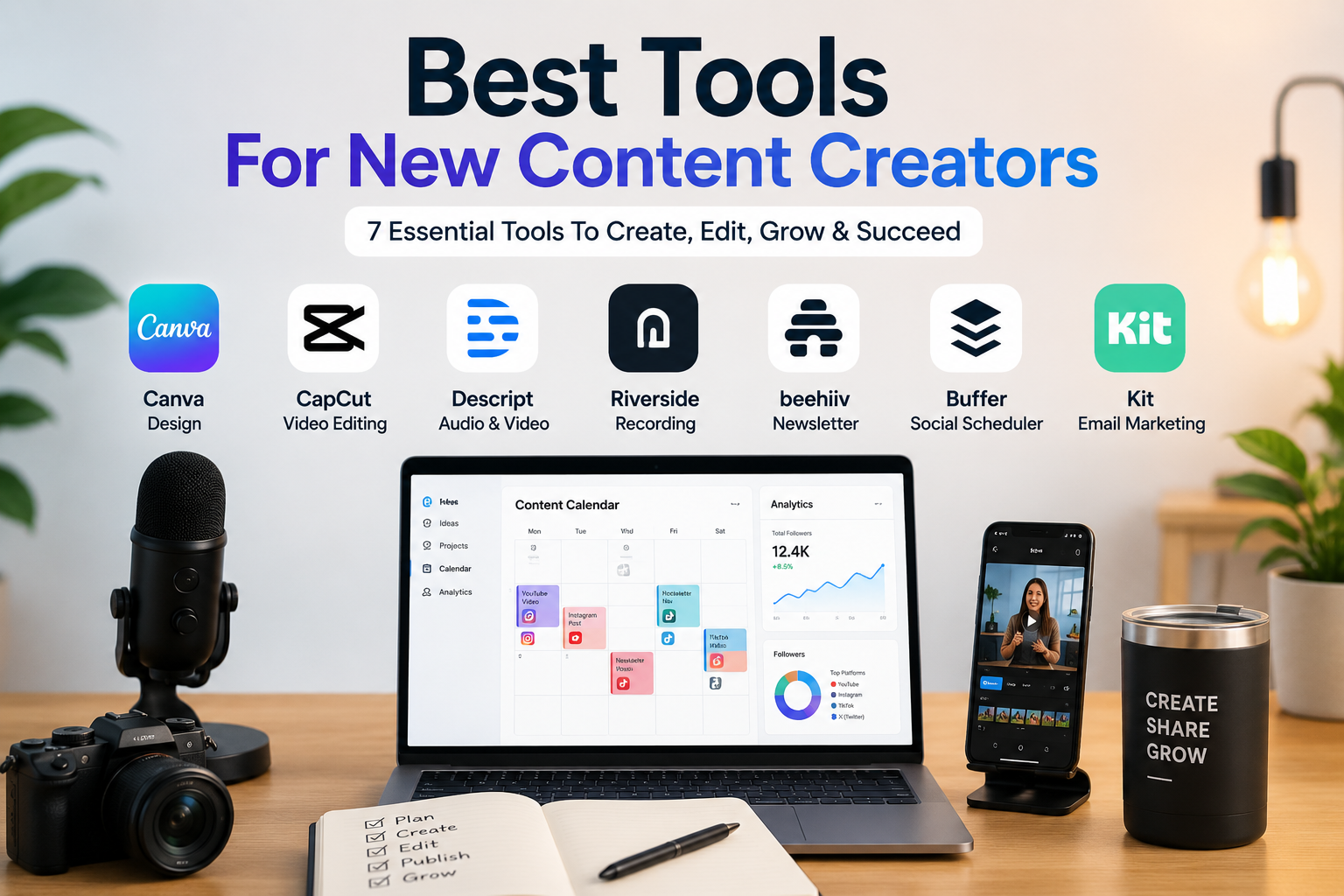
Creators still choosing the rest of their software can also read our guide to the best tools for new content creators.
What Could Make You Regret Your Choice?
Choosing Beehiiv Only Because Monetization Sounds Easy
An Ad Network does not make an audience valuable automatically.
You still need subscribers who open, read, click, and trust the publication. The platform provides access to monetization infrastructure, not guaranteed meaningful revenue.
Choosing Kit Only Because 10,000 Subscribers Are Free
A generous limit can postpone the payment decision.
It should not hide the free plan’s restrictions around automation and recommendation control.
Ten thousand subscribers inside the wrong workflow are not more useful than 2,500 inside the right one.
Building Complicated Automations Before Publishing Consistently
Creators sometimes spend days creating tags, sequences, and branching workflows before sending their first useful newsletter.
No automation can nurture subscribers who do not care about the content.
Paying for the Highest Plan Too Soon
Beehiiv Max and Kit Pro solve operational problems.
They do not solve weak positioning, inconsistent publishing, or unclear offers.
Treating Migration as Impossible
Moving later is inconvenient, but possible.
The more automations, tags, paid subscriptions, forms, and archived content you build, the more complicated migration becomes. That is a reason to think carefully now, not a reason to remain permanently trapped in an unsuitable platform.
Beehiiv vs ConvertKit: Final Recommendation
Beehiiv and Kit are both strong newsletter platforms.
They simply begin from different assumptions.
Beehiiv assumes that publishing, audience growth, and newsletter monetization belong at the center of the business.
Kit assumes that email should manage and develop the relationship between a creator, an audience, and several possible offers.
Choose Beehiiv when:
- The newsletter is becoming the product;
- You want a publication website and archive;
- Sponsorships or newsletter ads matter;
- Recommendations are central to growth;
- You plan to run several publications;
- Paid editorial content is part of the model.
Choose Kit when:
- The newsletter supports products or services;
- You need detailed tags and segmentation;
- Subscribers should follow different automated journeys;
- Purchases should change future emails;
- Courses, coaching, memberships, or launches generate revenue;
- Email needs to connect with a wider creator stack.
For a new newsletter writer, I would begin with Beehiiv Launch.
For a new creator building a list around future products or expertise, I would begin with Kit Newsletter.
For an established publication, Beehiiv Scale is usually the more coherent upgrade.
For an established creator business, Kit Creator is generally the stronger foundation.
The winner is not the platform with the longest feature table.
It is the platform whose internal logic already resembles the business you are trying to build.
Best newsletter-first platform: Beehiiv
Best creator-business email platform: Kit
Best publication and monetization ecosystem: Beehiiv
Best automation and segmentation system: Kit
Frequently Asked Questions
Is ConvertKit Now Called Kit?
Yes. ConvertKit officially rebranded as Kit. The product, website, and current plans now use the Kit name, although “ConvertKit” remains a common search term.
Is Beehiiv Better Than ConvertKit?
Beehiiv is better suited to newsletter-first publications, advertising, sponsorships, paid editorial content, recommendations, and public archives.
Kit is better suited to creator businesses needing automation, segmentation, product sales, and several subscriber journeys.
Which Platform Has the Better Free Plan?
Kit has the larger allowance, supporting up to 10,000 active subscribers.
Beehiiv supports up to 2,500 but includes unlimited sends, a publication website, campaign analytics, custom domains, and its Recommendation Network.
Does Kit’s Free Plan Include Automations?
Yes, but it is limited to one basic visual automation and one email sequence.
Creator and Pro unlock unlimited visual automations and sequences with more advanced rules and actions.
Does Beehiiv Take a Percentage of Paid Newsletter Revenue?
Beehiiv charges a 0% platform commission on paid subscriptions. Stripe’s standard processing fee still applies and is currently listed as 2.9% plus $0.30 for US transactions.
What Fees Does Kit Charge for Paid Products?
Kit currently charges 3.5% plus $0.30 per USD transaction for digital products and subscriptions. The amount includes payment processing.
Which Platform Is Better for Automations?
Kit is better for complex customer journeys using tags, purchases, forms, integrations, sequences, actions, and conditions.
Beehiiv offers capable newsletter-focused automations on Scale and above.
Which Platform Is Better for Paid Newsletters?
Both support paid newsletters.
Beehiiv is more attractive for a publication-first paid newsletter because it combines subscriptions with its website, archives, recommendations, advertising, and 0% platform commission.
Kit is stronger when the paid newsletter is connected to other products, subscriptions, or customer journeys.
Which Platform Is Better for Selling Courses?
Kit is usually the better option because purchases can connect directly to tags, automations, email sequences, integrations, and customer segmentation.
Does Beehiiv Allow Unlimited Email Sends?
Yes. All Beehiiv plans, including Launch, currently include unlimited email sends.
How Much Does Beehiiv Cost?
Beehiiv Launch is free for up to 2,500 subscribers.
At the 1,000-subscriber level, Scale currently starts at $49 monthly or $43 per month with annual billing. Max is approximately $109 monthly or $96 per month with annual billing.
How Much Does Kit Cost?
Kit Newsletter is free for up to 10,000 active subscribers.
For up to 1,000 subscribers, Creator currently costs $39 monthly or $390 annually. Pro costs $79 monthly or $790 annually.
Can I Move From Kit to Beehiiv Later?
Yes. Subscriber lists, content, domains, and paid subscriptions can be migrated, although automations and platform-specific structures may need to be rebuilt.
The difficulty increases as the account becomes more complex, so test the intended workflow before committing heavily to either platform.